The Weekly Poem: “Vigils”

[Happy Daylight Saving Time! With it, I announce my new goal: A submission a day, a poem a week, a story a month, a book a year. Let’s do this thing already!]
vigils

Vigils

Vigils are interesting.

Why always at night?

To be sadder, more dramatic?

People can mourn in the morning,

die during the day,

get introspective anywhere.

The candles wouldn’t even need to be lit

if the sun was up.


It struck me as

an inelegant elegy, a premature retrospective.

The funeral frontloaded and publicized.

A pat aftermath of fundraisers and belated favors.


Not insensitive, just intrigued.

Numb to the inevitable.

Always staring more than sharing

in a loss.


So when I did attend one,

the college President having passed to cancer a weekend prior,

I wanted to care—and did.

Still, a sense of intrusion loomed over me

as I marched to the plaza—

no tale to tell, no anecdote to impart.

As if spectating carried a scent

and out I’d be found.


But it didn’t matter.

It wasn’t cresting the hill

and seeing the place packed with solemn students.

Or the emcee’s invocation,

to thank us all for coming

and just wanting to say a few words before we all began.

Nor the moment of silence.


No, it’s the motions and emotions

only presence can capture.

Not the photographer’s exhibit of a tear-hardened cheek

or the paper’s front-page summary,

relegated to rusty coffee shop news-racks.

Sadness spreads,

and who we keep in our thoughts could fill a whole shelter,

but there’s no honor by proxy, no tristesse à deux.


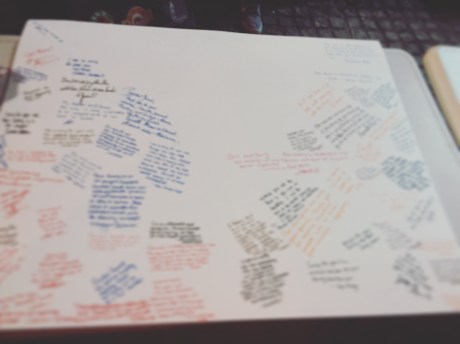
It’s the prone canvas of handwritten hopes, thanks, and well-wishes

on a foldout table to the side—

the eulogy democratized, a technicolor tombstone.

It’s the tremble of a dozen hands as they pen condolences,

and the shades chosen:

Black (traditional),

orange for vitality, pink for love, blue for hope.

It’s a tall Tupperware subbing as a donation box,

aflow with crisp and crumpled bills alike.

To attend is free, but everyone will contribute.

It’s how a man speaks about What She Meant to Me,


and, candle in hand, my pedantry melts in kind.

The weeping wax is a quick pinch

of the thumb en route to concrete,

and I should have known


we sleepwalk through work, play, and three square meals,

only to truly wake in the lonesome, cold, and eerie hours.

Death is a tide that stains instead of cleanses,

and the waves crash by dark

yet recede by day.

We can’t stop the storms, but we can build each-other lighthouses.

One wick to another, pale palms raised

to signal shore:

Faith. Thankfulness. Perspective.


The band lilts, coaxing notes

to lay a hand on bucking shoulders.

A sheet of music draped over the coffin to come.

There are minds and souls here, but no body,

and nobody is leaving just yet.


We are one wonder less,

wonderless the world still turns.

Better to learn it together,

to feel around emptiness and still take something out of it,

because memory is not a spectator sport.

– – –
A Blue View (Poem)

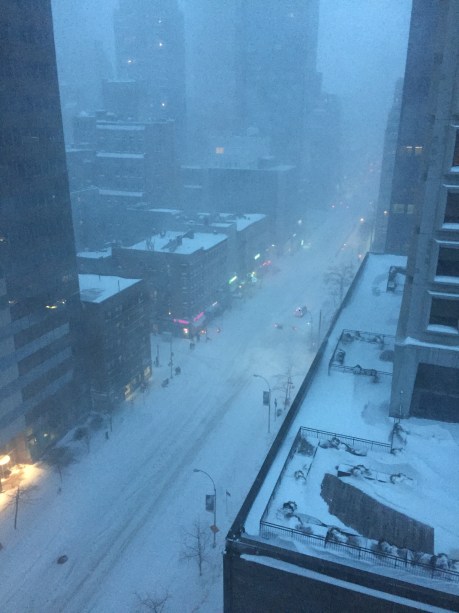
So believe it or not, for #Blizzard2016, I was stressed but cozy in a Manhattan lawyers’ conference room, practicing a moot court argument. But in snapping a few pics on break (Instagram: TNW24!), I was so struck (literally and spiritually) by the historically epic levels of snow that I decided to semi-freewrite a little poem:

A blue view, double digits up.

The reflections of our inflections

float over the snow like ghosts, and

it’s haunting,

this icy twilight, when sirens fire down empty avenues,

flakes swirling so the fall and rise look alike

to tired eyes lifting a headache

past glass, under a flickering light

over a lavish table.

Delicate delicacies and canned heat, bottled water—

an anxious banquet by holed-up hosts,

mostly confident we’ll make it out of here safely at dark.

As our floor scrapes the sky, so sleet scrapes the streets

in sheets, defeating any chance of steady wi-fi

or an uneventful stroll to the ATM.

The air occluded, Arctic darkness

blows gridwise in cold lines,

a hazy maze that shakes structures and ruptures Saturday plans.

The windows across are white-swept cells, clotted with frost.

The lights are off, and nobody home—

A law firm’s a bunker when New York is Nome.

IMG_6119

Hope everybody else in the area stayed safe and warm!

BACK IN BLACK AND/OR PINK – Valentine’s Up-Date

Happy Valentine’s Day! In my regrettable absence (full disclosure: no real reason, I just got busy and then Christmas Break happened/was pretty great), the rest of 2014 and the start of 2015 came and went without much in the way of remarkable developments–I made it through another semester at Cornell Law School with a modest cumulative 3.4 GPA and am preparing to advance to a higher editor position on the Cornell Law Review, but progress on my novel, “There’s Something Wrong with the Neighbor’s Cat” (link goes to pretty darn outdated character profiles) has been drip feed-esque at best, and the hunt for some manner of fulfilling legal work over the summer continues. Also, I’m trying to build a PC–parts so far include the processor, monitor, about twenty new Steam games, and this reasonably baller case:

It's on like TRON.

It’s on like TRON.

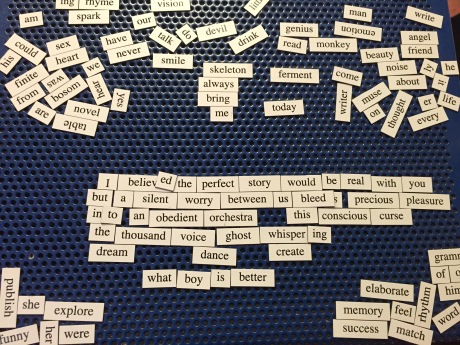
So since the only thing piling up more than sparkly, Solo cup-studded snow over here in Ithaca, NY is academic obligations, I’ll be brief in circling back around to that first joyful lead-in: It’s February 14th! Short story shorter, I’m still single, but if I wanted to straight bemoan the fact I’d send you a link to my Tumblr. Instead, in a bit of a “less is more” combo, I’ve got a pair of poems produced under varying circumstances. The first is another semiautobiographical magnetic poetry quickie I assembled while in the good ol’ “waiting room” at the UW’s English Department in the recesses of Padelford Hall while back home for the holidays. I don’t really name these ones, but I guess “What Boy” is as good a title as any:

What Boy

The second poem is one I actually wrote about a year ago, not coincidentally close to this time of the month. I didn’t share it initially because, to be honest, it’s pretty dang rough, schmaltzy, and was initially typed as “prose” on a lark describing the subject to a friend in a late-night Facebook message. I gave it and the reasons behind it some time to cool off, though, and figured today that it couldn’t hurt to toss it up again in light of the season, if only as something of an emotional time capsule–in any case, it’s vague enough that I’d like to think folks with a quirky, geeky sense of romance can relate to it (and I doubt those are in short supply on the internet!) , whether in a relationship or not. So again, just think of it as bittersweet “pop poetry,” and enjoy reading about a feeling that’s…

Hard to Describe

“Altography” [My Winter 2013 Honors Final!]

Oddly, I had a hard time picking a picture… this is the book that formed the basis of my “critique” for each image.

And now, for something completely different… something more complex and cerebral. Not to scare anybody away in the first few lines, but this is about my final for Honors English this last Winter quarter at the University of Washington! Under the guidance of the excellently-engaging Professor Caroline Simpson, we devoted our weeks as a close-knit “cohort” to the study of texts, essays, and film that explored and questioned the relationship between photography and… something that, off the top of my head, I think is best described as social change.

Did the pictures taken to expose the plight of Dust Bowl-era migrant workers really help their subjects, or just make people who saw them feel more fortunate? How much of the Abu Ghraib scandal would’ve even occured if no-one had recorded it? These questions and more drove the bulk of our group discussions, and while I was admittedly lost most of the time, I gleaned enough knowledge to eventually produce and submit this “creative thesis” (an option that mercifully arose halfway through the quarter)… for an overall course grade of 3.8!

The basic focus: Do the events, objects, and/or people immortalized in famous photographs retain their singular significance when an alternate angle or time of photography is imposed on the “Subject”? Or if an element of distortion–deliberate or not–is revealed in the “original” image? The piece proper, “Altography,” is right below, but if you want to read the more involved, academic explanation I prefaced my initial submission with, scroll down just a little further; you don’t have to read it, but it does explain the historical/critical background and terms utilized!

Altography

—————————–

Can an altered perspective operate on the same Subject and still arrive at a new, profound conclusion? While this was once the question which underlined the project contained herein, it quickly became a dilemma hanging over its very formation when my goal reared up as both vague and self-limiting. A hope to better unite the scattered poems came in the form of Camera Lucida, and as my research evolved, I went from merely nodding at Barthes’ words above to deliberately challenging the limitations they declared. Barthes speaks at length on the tension between a great photograph’s studium (the obvious points of interest) and its punctum (an indefinable depth found in subtler aspects), but in turn laments the unary nature of news photographs, with “no duality, no indirection, no disturbance” (41). Applied to those journalistic snapshots which dominate the public perception of a complex Subject, this I could not deny—but could something akin to the punctum exist just “outside” the frame, understood in relation to another photograph?

It wasn’t until I encountered the “surprises” (to his Spectator; “performances” to the Photographer) characterizing photographic “shock” that I understood how to define that exterior quality. These five elements— the “rare,” the numen (rapidity immobilized), prowess, contortion, and the trouvaille (lucky find)—were not established as those of the punctum, but Barthes’ later revelation that “there exists another punctum… Time, the lacerating emphasis of the noeme (“that-has-been”), its pure representation” (96) reveals his knowledge of the possibility. The Subjects inhabiting these photographs are all unique, as are the ways in which they proffer “alternative” sides beyond different physical angles—a sub-punctum of sorts, in the seconds, meters, and manipulations separating different referents from the same Subject. There they wait, ready to expand an inherent disorientation into a space to break down and re-form assumptions surrounding Photography, particularly that of an allegedly “unary” nature. Does the frame end where the device itself captured it, or where the creator chose to crop it? Is something “added” to a photo if the contents are only switched around? Reflecting through images alone, when can an Event be said to have officially “happened”?

In attempting to answer these questions, it is my hope that the endeavor is not taken as a mere “shock to the system,” a childish surprise attack from around-the-corner. It is also my hope that the form serves the focus, for I employ melodic prose poetry with the intent to strike a balance between artistic, aesthetic introspection and academia, freeing the former from the (chrono)logical constraints of the latter while still invoking critical discourse. These poems are not puffed-up captions, but neither are the photographs which accompany them mere illustrations to an experimental essay. If ambiguity seems to pervade the pieces, it is only by the virtue of disassembling their focus: the Realm of the Photograph, where a single detail can tip the balance of visions or memory from godlike certainty or meaningless confusion. That textual quotations selected (rendered in italics) run by the same binary is no accident; for Spectator, Photographer, and Subject alike, Barthes is once again apt when he assess that a (famous) Photograph “completely de-realizes the human world of conflicts and desires, under cover of illustrating it” (118). But no matter the era, professional or amateur, black and white or color, we needn’t panic at that thought. Sometimes, if our sight is filled, we need only shift our heads.

“Dour Number One”

...so don't swat it in the process of looking for more!

…so don’t swat it in the process of looking for more!

Poem number six, coming right up! This one’s prompt was for a “sonic poem” that values rhythm and rhyme over coherence, and the possibility of a rap-like piece was suggested if not recommended. As such, the exercise became something of a welcome excuse for me to practice my hip-hop chops, though a performance of this “on tha mike” is pending, because I’ll admit the beat isn’t perfect all the way through. Still, I kind of had fun with it, and I hope the sentiment I injected still makes sense in-between all the alliteration and assonance!

Dour Number One

“Shuffle Mode” (+OFFICIAL LOVE&DARKNESS PLAYLIST!)

Emo as I wanna be today.

Emo as I wanna be today.

Well, happy Valentine’s Day, all! Although I’ve got all kinds of rough drafts for Love&Darkness: Vol. II stewing on my computer right now, I’m afraid writing a third brand-new story last week to release it in time for the holiday was just not in the cards. However, thanks to my latest ENGL 483 prompt–and I say “mine” because I was the one who came up with it for the whole class–there is a new poem! Inspired by my love/hate relationship with T.S. Eliot (“the Kanye West of poets,” as I’m on record calling him), I decreed that we focus on a “referential poem,” one composed of literary/(pop) cultural references, or at least tasteful name-dropping. I decided to write one based on an old hobby of mine: chickening out talking to women and venting my frustration by listening to pop punk.

Shuffle Mode

(How many band names can you pick out?)

——-

And speaking of emotional music… almost as long in making as the book itself, I present to you the Official Love&Darkness Playlist! It’s composed of songs that inspired me while writing the collection, songs that remind me of particular stories, and songs that I feel just embody the ideas of “love” and “darkness” as I set out to write about them. Since I don’t know how to embed a streaming playlist from Rdio or something (whatever happened to that option on iTunes, anyway?), I’ve just put YouTube links to the most convenient rip of each one (stupid ads aside). Listen on your own time, or while reading for added effect!

The Official Love&Darkness Playlist (Vol. I)

1) “Distraction” – Angels & Airwaves

2) “Living Dead Girl” – Rob Zombie (“All of My Ex-Girlfriends Are Monsters”)

3) “One Day Women Will All Become Monsters” – Chiodos (…Or this; take your pick)

4) “Gave Up” – Nine Inch Nails (“It’s No Use…”)

5) “A Daydream Away” – All Time Low (“But Crazier Things Have Happened”)

6) “Right Where it Belongs” – Nine Inch Nails (“Fear Itself,” “The Agents of Fear”)

7) “Ghost on the Dance Floor” – Blink-182

8) “Of Wolf and Man” – Metallica (“Were”)

9) “Veronica Sawyer Smokes” – AFI

10) “Harder Than You Know” – Escape the Fate (“How Does it Feel?”)

11) “The Curse of Curves” – Cute is What We Aim For (“Hi!”)

12) “Fix You” – Coldplay (“‘One Thousand Ways”)

13) “Hysteria” – Muse (“In Finiti”)

14) “Love Like Winter” – AFI

15) “About a Girl” – The Academy Is…

16) “Semiotic Love” – Blaqk Audio (“Keep Reading”)

17) “The World You Love” – Jimmy Eat World

18) “The Scientist” – Coldplay

19) “Chasing Cars” – Snow Patrol

20) “Fake Plastic Trees” – Radiohead

21) “Summertime” – My Chemical Romance

22) “Run” – Snow Patrol

23) “I Will Follow You Into the Dark” – Death Cab for Cutie

“Let Go” (It’s a Poem. About Legos.)

Image from tracizeller.com

So yes! After rustling some jimmies with my takes on gendered maturity and antidisestablishmentarianism, I decided to go back to basics with a poem about how… I really like Legos:

Let Go

———–

The prompt was for a “bare poem” this time, with no more than ten lines and under ten words per line, and no adverbs. I went for broke on sound, then, while still maintaining what I hope is an apparent rumination on why contructing these things is so psychologically pleasing.

On a related note, I’ve been getting back into the habit with these fancy Lego Architecture sets! I knocked out Frank Lloyd Wright’s “Fallingwater” a few weeks ago, and completed a small model of the hitherto unfamiliar-to-me Villa Savoye just this evening.

“The Cookbook’s Anarchist” (+Strange Street Men Are Interested in L&D)

Hot on the heels of the last fruit of my labor from English 483 with Linda Bierds (“Girls and Women,” which has already been called “great,” “wonderful,” “controversial,” and “misogynistic”) comes this little political nugget. The prompt (these are decided on by alternating groups of students, for the record): produce an “emblematic poem,” in which an observation on the physical nature of a subject segues into deeper rumination. Loosely based on an actual anarchist publication I saw hanging around at the UW, my only hope is that I don’t expose how little I honestly know about world government while attempting to do the same to others.

The Cookbook’s Anarchist

——-

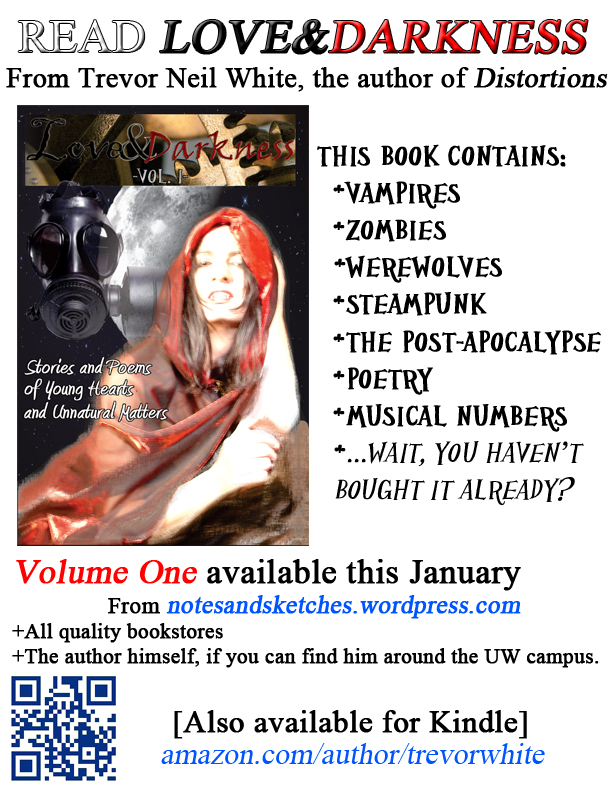
Also, my brother Kyle tells me that, the other evening, a scruffy, possibly unstable man wandered into our apartment lobby and–after some consideration–enthusiastically picked up one of my fliers for Love&Darkness before exiting as questionably legally as came.

Could this be just the teen fiction anthology that Seattle’s underground homeless network needs?

LaD Flier

Girls and Women (and Underground Cafés and Sales Figures)

This last Thursday, I had the pleasure of both implicitly hosting and taking part in an open mic night at the University of Washington! That is, the event was put on by the Bricolage Literary Arts Journal (of which I am Treasurer), though there was some carry-over in attendance from the first general meeting for Sigma Tau Delta English Honor Society (also Treasurer of that) an hour prior. The event was hosted in the subterranean Parnassus Café of the Art building, a dimly lit but warmly inviting place for poets and musicians of all stripes.

The turnout? Excellent! Granted, the room has a capacity cap of about seventy, but anybody in the Seattle area who’s interested can also check out further open mics sponsored by Manic Mouth Congress every other Thursday, 7-9pm, starting January 24.

The evening’s material was full of superbly-written, well-delivered pieces, running the gamut from a spoken-word feminist declaration to an acoustic song about a Yeti. When it was my shot at the spotlight, I cleared my throat, rose the microphone stand considerably, and read a pair of poems: Christmastime, from Love&Darkness: Vol. I, and the following poem, one based on couplets that I recently wrote for my current poetry class (English 483 with Linda Bierds, which is going excellently so far):

Girls and Women

——-

On a slightly related note, I would like to personally thank electronic musician, fellow blogger, and guy from Michigan Truttle for laying down his digital dollar for the first official online purchase of Love&Darkness: Vol. I! If you’re on your way to PayPal checkout for your own copy, don’t forget to stop by his Bandcamp page to pick up some sweet ambient tunes.

From the Sub-Subfolders: And Yet So Far

Alright, folks! This time we have another poem from that ubiquitous Centralia College CW course (PDF’d and revised for poetic grammar, of course), for which the prompt was to write about some manner of mythology or legend. Perhaps feeling a bit of empathy with the guy at the time, I chose Tantalus.

And Yet So Far